
July 3, 2026
How to Change Careers at 40 Without Starting Over
By AI Pivot Map
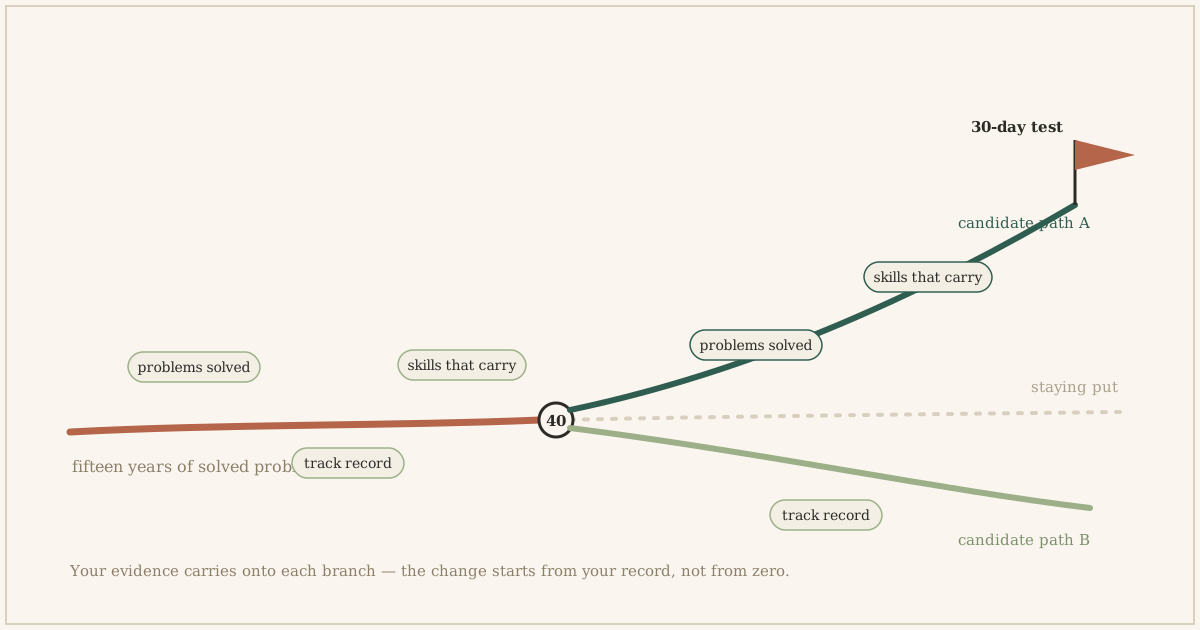
The worry behind a career change at 40 is rarely about ambition. It is practical: income needs, commitments to other people, limited runway for experiments, and an established track record you do not want to throw away. If changing course means starting over, the change looks unaffordable — so many people never examine it at all.
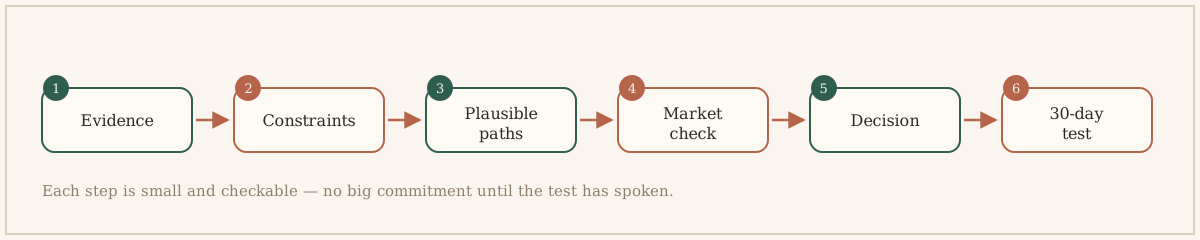
Some career changes genuinely are restarts — a move into a licensed profession usually is. But many are adjacent moves, where your existing evidence, domain knowledge, judgement, and problem-solving experience still count. The way to find out which kind yours would be is not a pep talk. It is a short sequence of checks you can run yourself: evidence, constraints, plausible paths, a market check, and one small test.
None of it requires resigning, retraining, or telling your employer anything. Those decisions come later, if the evidence earns them.
Why "starting from zero" is the wrong frame at 40
"Starting from zero" bundles three separate fears into one: junior pay, a discarded track record, and years of retraining. Taken together they feel like a verdict. Taken apart, each becomes a question you can actually check — and questions have answers, where verdicts only have obedience.
The deeper error is treating a career as a ladder, where leaving means climbing down before you can climb again. Work is closer to a long record of problems solved for people who needed them solved. Job titles are local; problems repeat across industries. An established track record is evidence, and much of it can still count elsewhere — the checks below exist to find out how much, in your case.
The stakes are real, which is exactly why guessing is the thing to avoid. The method below replaces guessing with checking, one deliberately small step at a time.
Inventory the evidence in your track record
Before you look at a single job title, spend one evening building a one-page inventory. Three columns: what you did, the problem it solved, and who valued it. Fill it with concrete items — projects delivered, budgets managed, teams run, messes cleaned up, decisions made under pressure.
Write artifacts, not adjectives. "Strong communicator" proves nothing; "wrote the proposal that kept our largest account" is evidence someone could check. If a line would not survive a sceptical interviewer asking "show me", rewrite it until it would.
An AI tool can speed this up — paste in a plain description of your roles and ask it to suggest evidence you may have overlooked. Treat the output as a first draft to verify line by line, and keep confidential employer information out of the prompt. The inventory only works if every line on it is true.
Separate preferences from hard constraints
Before any path is considered, decide what is actually fixed. A hard constraint is a fact of your situation. A preference is something you would like. Most stuck decisions come from treating preferences as constraints, or constraints as details.
| Hard constraint (does not bend) | Preference (bends for the right move) |
|---|---|
| A monthly income floor you cannot go below | The income you would prefer |
| Staying within reach of your current city | A shorter commute |
| Being present for family commitments on set days | Fully remote work |
| A qualification you genuinely cannot fund this year | Prestige of the new field |
The rule is blunt: a path that breaks a hard constraint is out, no matter how appealing it looks. Preferences, by contrast, are negotiable — and knowing which is which is what makes the next step honest. Revisit the split if your circumstances change; it is provisional, like everything else in a first map.
Find the adjacent paths your evidence points to
An adjacent pivot is a move where a meaningful part of your evidence already counts: the industry knows you, or the problem type knows you, or the tools know you. A restart is a move where little of it counts. The inventory exists to show you which candidate moves are adjacent for you — and which would be true restarts.
Read your one-page inventory and ask: which problems have I solved repeatedly, and which roles exist mostly to solve those problems elsewhere? Write down two or three plausible paths — not one. A single option becomes a fantasy to defend; two or three become candidates to compare.
Hold the list loosely. This is a first map, not a commitment. Adjacency makes a path a sensible place to start checking — it does not prove the market wants it. That is the next step's job.
A plausible path is not automatically an easy path
Adjacency tells you where your evidence might count. It does not tell you how much is missing. A path can reuse most of your record and still contain a real gap — a credential, a tool, a body of knowledge the role treats as non-negotiable.
The point of the next two steps is to size that gap honestly. A narrow gap — one skill, one tool — is something you can test within weeks. A wide gap does not make the path wrong, but it may make it unrealistic for now, and it changes what a sensible test looks like. Knowing which kind of gap you are facing is worth more than optimism about it.
Check real listings before you believe a path
For each candidate path, review a useful sample of recent job listings from the region — and the work arrangement, whether on-site, hybrid, or remote — you would genuinely accept. Read them slowly and note the requirements that keep recurring across the sample; a single odd listing means very little.
Then hold the listings against your inventory. Mark where your evidence already meets a recurring requirement, and where there is a genuine gap. The matches tell you how much of your record transfers. The gaps tell you exactly what a test must probe — and what any eventual training must cover, which is usually far narrower than a full retraining.
Listings are direct evidence of what employers were advertising for at that moment — no more. They do not tell you what the work feels like day to day, or which requirements are actually negotiable. So do not take anyone's word for what a field requires — not a friend inside it, not an AI summary, and not this article. The listings are primary evidence of advertised requirements; everything else is a draft to verify against them.
Design a 30-day test before any big commitment
The expensive mistakes at 40 share one shape: a large, hard-to-reverse commitment made before any real contact with the work. Resigning first. Enrolling in a long course first. The 30-day test inverts the order: the smallest real contact with the actual work, before any major commitment.
A test can be modest: a bounded personal project that produces one work sample the new field recognises, a day observing the actual workflow where someone is willing to host you, a relevant industry event, or a handful of structured conversations with people already in the role — each one probing the gaps your market check exposed. Decide in advance what you need to see for the path to stay alive.
Some paths, such as licensed professions, cannot be fully tested in thirty days. Test the nearest testable slice instead — the daily texture of the work, not the credential. A test does not make the outcome certain; it makes the cost of being wrong small enough to afford.
What to do next
This week, do one modest thing: build the one-page evidence inventory, pick the single most plausible path it suggests, and review a sample of recent listings for it. Note the requirements that recur most. That single page of evidence will tell you whether the path deserves a 30-day test — and either answer is progress.
You do not need to know your final destination at 40. You need one path worth investigating and a cheap, honest way to check it. That is a decision problem — and you have more evidence to decide with now than at any earlier point in your career.
If you would like a structured way to work through this, the AI Career Pivot Map is a one-time €39 toolkit: a 24-page guide, a 28-page fillable workbook, and a 12-page prompt library that walk you through evidence, constraints, plausible paths, a market check, and a 30-day test. Explore the AI Pivot Map.